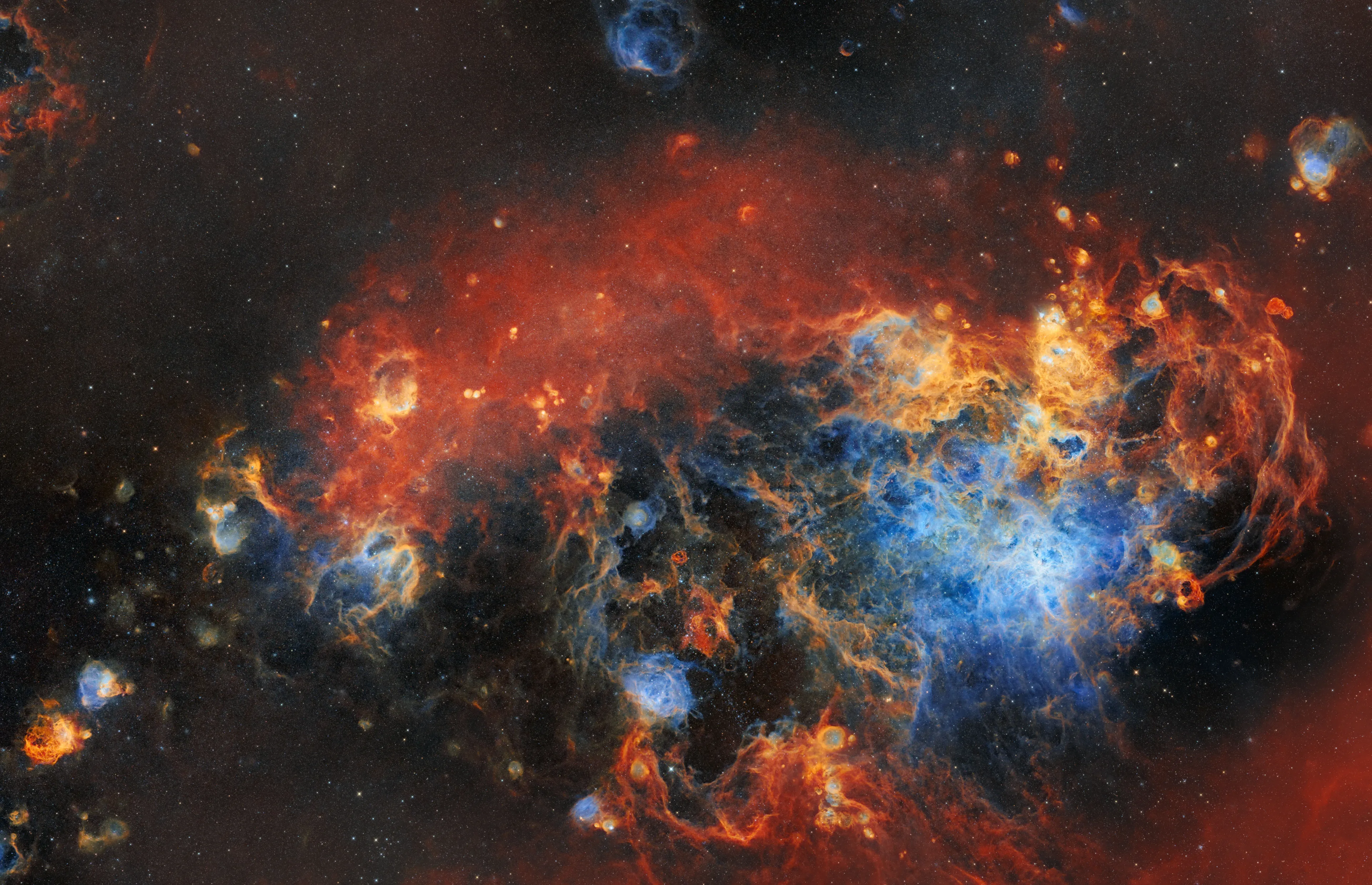
Elsewhere in this gallery, a single star-forming region takes a mosaic of thirty panels. Here there are dozens in one frame, because they belong to another galaxy 160,000 light-years off. That common distance is what makes the LMC so useful: everything in it sits at the same range, so brightnesses can be compared directly without solving for distance first, which is why the galaxy has become the benchmark for the whole cosmic distance scale. It also holds roughly half the heavy elements our galaxy does, closer to the composition of the early universe, so the star formation you’re looking at runs under conditions the Milky Way outgrew long ago. The palette maps elements rather than appearance: blue for ionised oxygen near the hottest stars, orange for sulphur and hydrogen in cooler gas. Supernova 1987A, the nearest in nearly four centuries, exploded in this galaxy.