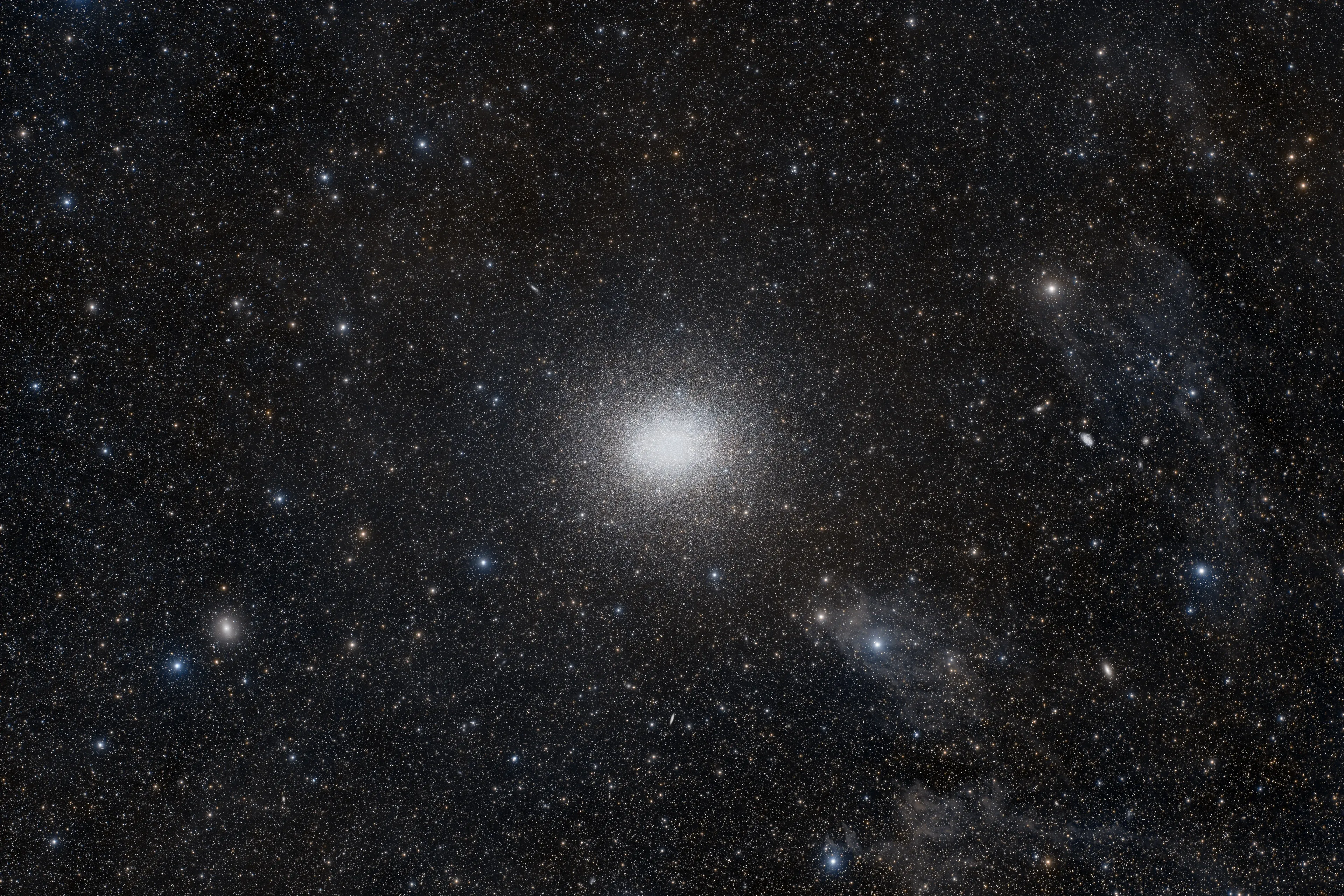
Ptolemy listed this as a star, and Bayer gave it a Greek letter the way you would any other star; nobody recognised it as a swarm of suns until Dunlop resolved it in 1826, and the stellar name stuck anyway. It holds something like ten million stars and it’s the largest globular attached to our galaxy, but the interesting part is what’s inside: unlike an ordinary globular, whose stars formed together and share a composition, Omega Centauri contains several populations of different ages and metal content. That’s the signature of an object that ran its own star formation for a long time, which is why it’s widely thought to be the stripped core of a dwarf galaxy the Milky Way absorbed. Roughly 17,000 light-years away, and bright enough to see without optics if you’re far enough south.