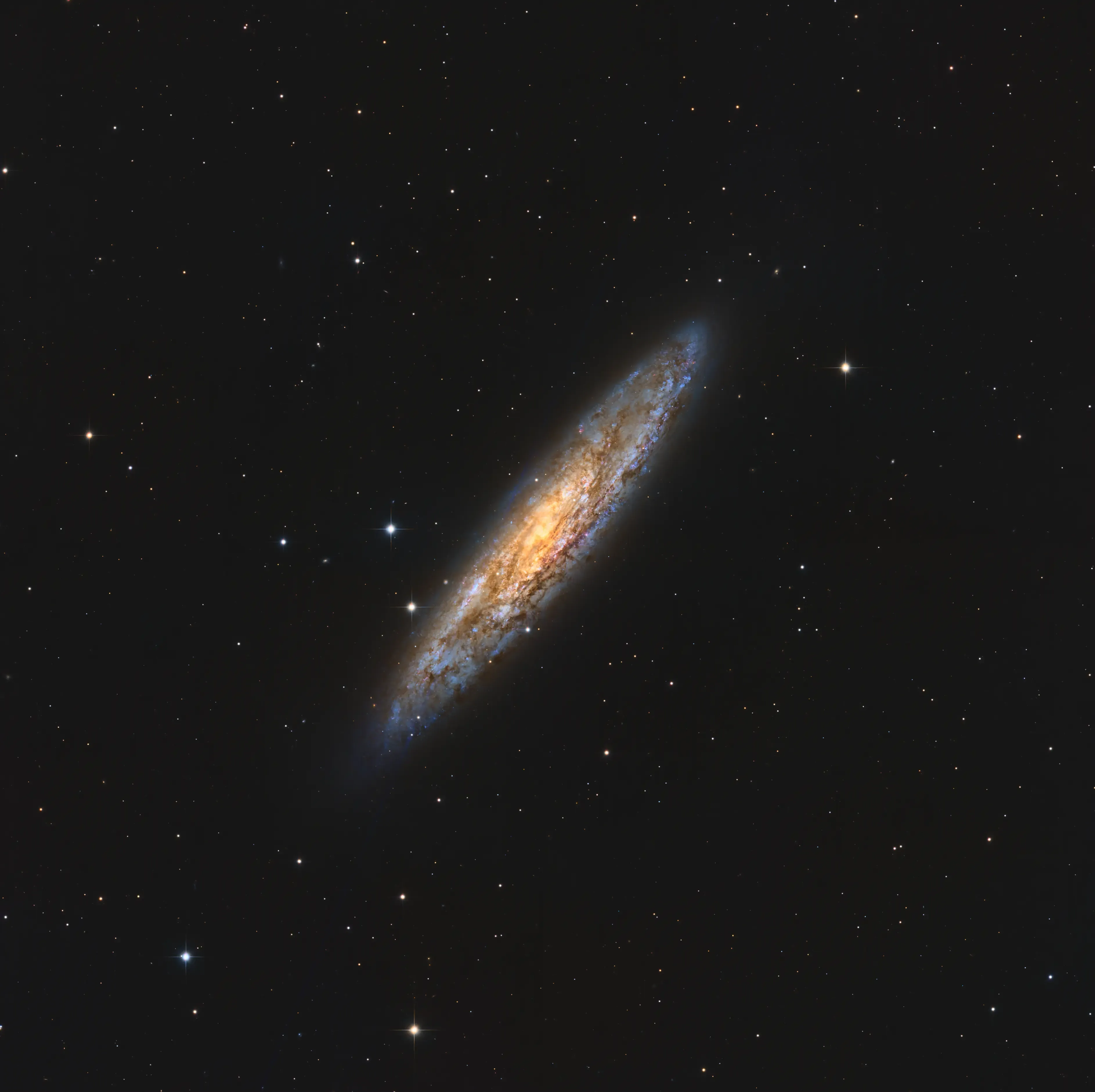
This wasn’t imaged to be looked at. The filters are Bessell B, V and R, standardised passbands used for photometry, which means the brightness of every star in the frame can be measured and compared against any catalogue in the world. The V band sits around 550 nanometres, close to the peak of human eye sensitivity, because that’s what it was designed to imitate. Mapping the three bands to blue, green and red gives the colour you see here, so nothing in this rendering was chosen for looks: it’s what falls out of a filter set built for measurement. Most astrophotography runs the other way, with filters picked to make an image. This is the image that happened to a data set.
Compare the dust here with the neat arms of a quieter spiral: it’s blotchy, tangled, spread through the whole disk. That’s what a starburst looks like from outside. NGC 253 is turning gas into stars at a rate an ordinary galaxy can’t sustain, most of it concentrated in a core buried so deep in dust that visible light barely escapes. All that star formation drives an outflow of hot gas above and below the disk, though you’d need X-rays or a hydrogen filter to see it; what shows up here is the mess it came from. Caroline Herschel found this galaxy in 1783 while sweeping for comets, more than a century before anyone knew what a galaxy was. It’s about eleven million light-years away in Sculptor, and it sits high enough in southern skies to be an easy target from here.