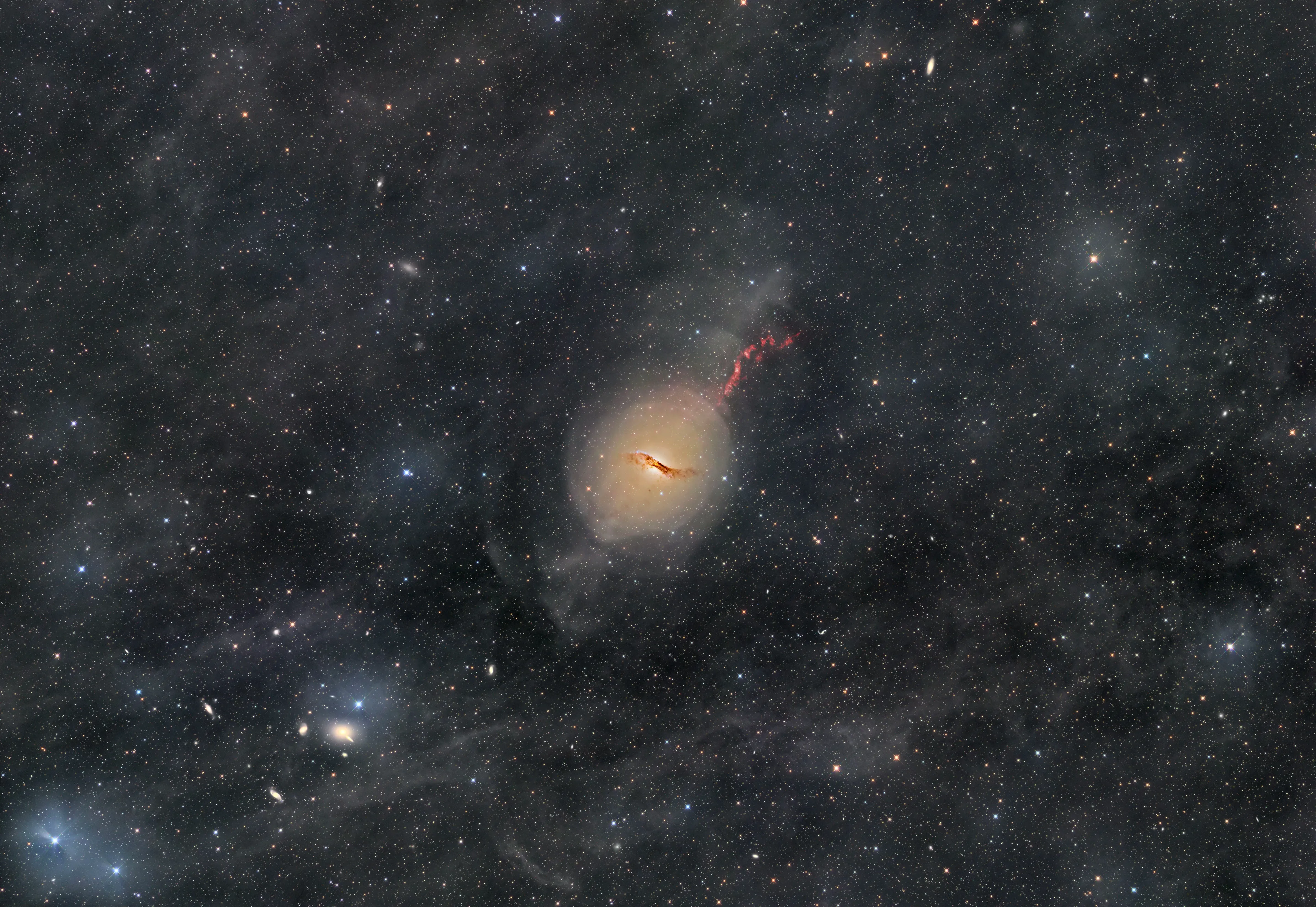
The dark band across the core is what’s left of a spiral galaxy this elliptical absorbed, still settling. From the nucleus, a jet driven by a supermassive black hole runs out to the upper left, and the red filaments strung along its path are gas responding to it, at tens of thousands of light-years from the centre, with young stars forming in the wake. Then there’s the grey haze covering the whole frame, and it has nothing to do with any of that: it’s dust in our own galaxy, a few hundred light-years away, faintly lit by the combined starlight of the Milky Way. Two of the faintest structures in this image, one extragalactic and one local, separated by a factor of roughly a million in distance. Cen A is about twelve million light-years away, the closest active galaxy to us. The hydrogen data that brings out those filaments came from Wijaya Sukwanto and Robin Lim.