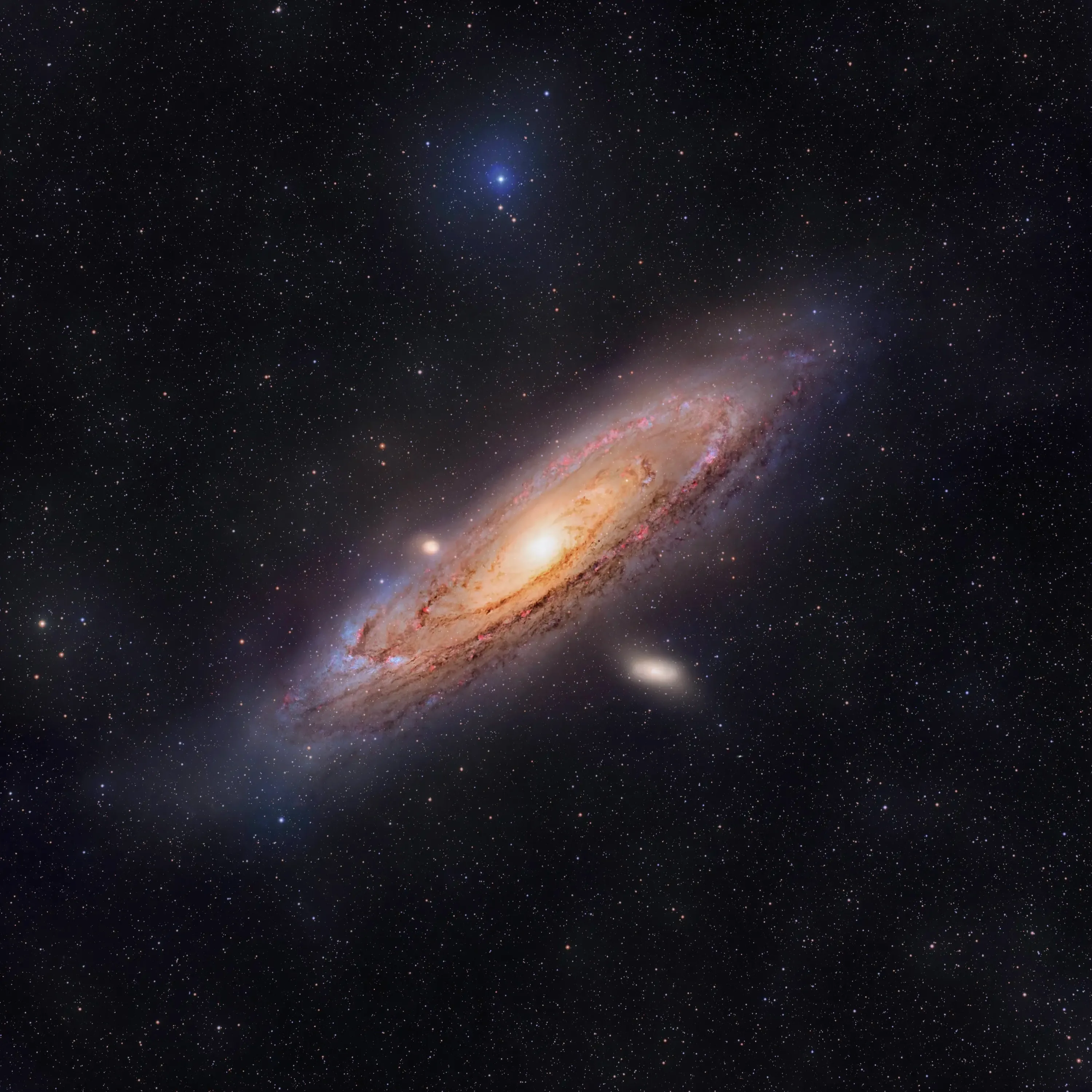
Until the 1920s nobody could say whether the spiral nebulae were clouds inside our own galaxy or systems of their own. Hubble settled it with this one: a Cepheid variable found on a photographic plate of M31 in 1923 gave a distance far beyond anything in the Milky Way, and the known universe expanded overnight from one galaxy to countless. It’s 2.5 million light-years off, which makes it the most distant object most people will ever see with their own eyes, and it’s approaching us at around 110 kilometres per second. The compact round companion pressed against the disk is M32; the larger, softer one is M110. The bright blue star at the top belongs to our galaxy and sits millions of times closer.